Overview
In the presence of organic peroxides, the addition of hydrogen bromide to an alkene yields the isomer that is not predicted by Markovnikov’s rule. For example, the addition of hydrogen bromide to 2-methylpropene in the presence of peroxides gives 1-bromo-2-methylpropane. This addition reaction proceeds via a free radical mechanism, which reverses the regioselectivity. The free radical reaction mechanism involves three stages: initiation, propagation, and termination.

In the first initiation step, an oxygen–oxygen bond in the radical initiator undergoes homolytic cleavage.

The di-tert-butyl peroxide is an excellent free-radical initiator as the homolysis of the O–O bond requires just 159 kJ mol–1 (38 kcal mol–1) of energy.

The second initiation step involves the exothermic (ΔH = –70 kJ mol–1) abstraction of hydrogen from HBr by the tert-butoxy radical. The abstraction of bromine, however, is thermodynamically unfavorable (ΔH = 163 kJ mol–1).
In propagation steps, a bromine radical reacts with an alkene to generate an alkyl radical.
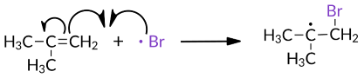
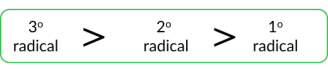
The regioselective addition of bromine at the less substituted carbon in the presence of peroxide can be understood from the transition states. The transition state shows that the formation of the more substituted radical involves an attack by a bromine radical at the less substituted (and less hindered) carbon atom, which is lower in energy than the transition state for the less substituted radical. Another reason is the stability exhibited by the more substituted radicals owing to the hyperconjugation and inductive effect.
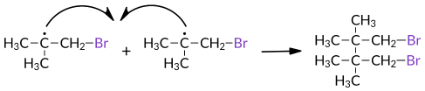
The reaction is terminated when radicals combine to yield non-radical products.

While the peroxide-mediated addition of HI to an alkene does not occur because the first propagation step is endothermic, the reaction with HCl does not proceed as the second propagation step is endothermic.
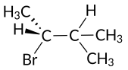
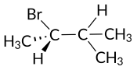
In the addition of hydrogen bromide to an alkene, the bromine radicals can attack the less substituted vinylic carbon from either face to an equal extent. Hence, when an alkene is stereogenic, a racemic mixture of products is obtained.
Procedure
While hydrogen bromide typically adds to an unsymmetrical alkene like 2-methylpropene to form the Markovnikov product, in the presence of peroxide, the alternate regioisomer — the less-substituted alkyl halide — is obtained.
Anti-Markovnikov regioselectivity, called the peroxide effect, is attributed to a free-radical reaction mechanism in the presence of peroxide.
In the first initiation step, the weak oxygen–oxygen bond in peroxide breaks homolytically, as indicated by a fishhook arrow, in the presence of heat or light to form alkoxy radicals. The second initiation step is abstraction of hydrogen from hydrogen bromide by an alkoxy radical, releasing the bromine radical.
The selective abstraction of hydrogen over bromine by the alkoxy radical is explained by the relative enthalpies of the oxygen–hydrogen and oxygen–bromine bond formation reactions.
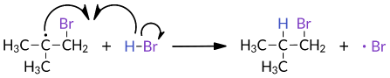
The propagation sequence is marked by the addition of a bromine radical to the less-branched carbon of the alkene, producing a more-substituted alkyl radical. The chain reaction is set up as the alkyl radical abstracts hydrogen, again forming a bromine radical. For each radical consumed in the propagation step, another is produced.
As the reactants are depleted, radicals combine with each other, terminating the chain reaction.
The formation of the anti-Markovnikov product in the presence of peroxide is partially due to less steric hindrance being posed to the incoming bromine radical by the less-branched end of the alkene, producing a lower-energy transition state.
Another reason is the formation of a more stable alkyl radical when bromine reacts at the less-substituted carbon as tertiary free radicals are more stable than primary ones.
Interestingly, the peroxide effect is not observed with hydrogen iodide and hydrogen chloride, as the propagation steps of addition of the iodine radical to the alkene and the reaction of the alkyl radical with hydrogen chloride are thermodynamically unfavorable.
During the addition of hydrogen bromide to an alkene, the bromine radical can approach from either face of the alkene. Hence, when a new chiral center is generated, a racemic mixture of the product is obtained.