Overview
Introduction
Alkynes can be prepared by dehydrohalogenation of vicinal or geminal dihalides in the presence of a strong base like sodium amide in liquid ammonia. The reaction proceeds with the loss of two equivalents of hydrogen halide (HX) via two successive E2 elimination reactions.
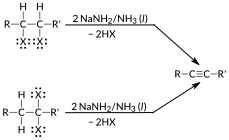
Reaction Mechanism – E2 pathway
Vicinal dihalides
In the first elimination step, the strong base abstracts the proton from the dihalide that is oriented anti to the leaving group. Since E2 reactions follow a concerted pathway, the abstraction of a proton and departure of the halide leaving group occur simultaneously to form a haloalkene.

In the second elimination reaction, another equivalent of the strong base reacts with the haloalkene in a similar fashion to give the desired alkyne.

Geminal dihalides
Likewise, geminal dihalides, when treated with two equivalents of a sodium amide, undergo double dehydrohalogenation to give alkynes.


Terminal dihalides
Dehydrohalogenation of terminal dihalides yields terminal alkynes as the final product. In the presence of a strong base like sodium amide, terminal alkynes get converted to acetylide ions. In such cases, a third equivalent of the base is required to complete the dehydrohalogenation of the remaining haloalkene.

Protonation of the acetylide ions with water or an aqueous acid completes the reaction.

Application in Organic Synthesis
Dehydrohalogenation of vicinal dihalides is a useful intermediate step in the conversion of alkenes to alkynes. For example, chlorination of 1-propene gives 1,2-dichloropropane – a vicinal dihalide, which upon double dehydrohalogenation yields 1-propyne.

Similarly, alkynes can also be synthesized from ketones via dehydrohalogenation of geminal dihalides. For example, treatment of acetone with phosphorous pentachloride yields 2,2-dichloropropane – a geminal dihalide, which undergoes double dehydrohalogenation to give 1-propyne.

Procedure
In addition to the alkylation pathway, alkynes can also be prepared by dehydrohalogenation of vicinal or geminal dihalides.
Vicinal dihalides are compounds with halogens on adjacent carbons, whereas compounds with halogens on the same carbon are called geminal dihalides.
For example, a vicinal dichloride can be synthesized from an alkene by the addition of chlorine in the presence of an inert solvent like dichloromethane. While a geminal dichloride can be prepared by treating a ketone with phosphorous pentachloride.
In the presence of a strong base like sodium amide in liquid ammonia, the dihalides lose two equivalents of hydrogen halide through two successive E2 elimination reactions. Hence the name double dehydrohalogenation.
The first elimination reaction proceeds with the abstraction of a proton by sodium amide and simultaneous departure of the halide leaving group to form a haloalkene.
In the second elimination reaction, another equivalent of the base reacts with the haloalkene to yield the desired alkyne. Thus, at least two equivalents of sodium amide are required for the reaction to go to completion.
Similarly, treatment of geminal dihalides with sodium amide gives alkynes through two consecutive E2 elimination reactions.
However, if the product is a terminal alkyne, the acidic hydrogen is deprotonated by the strong base to form an acetylide ion. Thus, a third equivalent of the base is required to complete the dehydrohalogenation of the remaining haloalkene. Protonation of the acetylide ion with water or a weak acid drives the reaction to completion.
If the first elimination step gives a haloalkene with hydrogen on adjacent carbons, subsequent elimination can yield an allene as a side product in addition to the alkyne. However, the presence of adjacent double bonds in an allene makes them more unstable, thereby favoring the formation of alkynes.
Lastly, the reaction can be terminated at the first elimination step using weaker bases like sodium hydroxide to give an alkene as the final product.