Overview
UV–Visible absorption spectra of conjugated dienes arise from the lowest energy π → π* transitions. The light-absorbing part of the molecule is called the chromophore, and the substituents directly attached to the chromophore are called auxochromes. A strong correlation exists between the absorption maxima, λmax, and the structure of a conjugated π system. The Woodward–Fieser rules predict the value of λmax for a given structure by adding the contributions from various substituents to a base wavelength, which remains fixed for a given class of dienes or trienes. The applicability of Woodward–Fieser rules can be extended to α,β-unsaturated carbonyl compounds.
Woodward–Fieser Rules for Dienes
- Base value:
- Acyclic diene = 214 nm
- Homoannular diene = 214 nm
- Heteroannular diene = 253 nm
- Substituent contributions:
- Double bond extended conjugation = 30 nm
- Ring residue = 5 nm
- Exocyclic double bond = 5 nm
- Substituent groups:
- Alkyl group = 5 nm
- –OR = 6 nm
- –Cl, –Br = 5 nm
- –NR2 = 60 nm
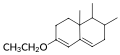
Figure 1.
Calculation for Figure 1:
Base value (Heteroannular diene) = 214 nm
Three ring residues = 3 (5 nm) = 15 nm
One exocyclic double bond = 5 nm
One –OR group = 6 nm
λmax (calculated) = 240 nm
λmax (observed) = 241 nm
Woodward–Fieser Rules for α,β-Unsaturated Carbonyl Compounds
- Base value:
- Acyclic or six-membered cyclic enones = 215 nm
- Five-membered cyclic enones = 202 nm
- Substituent contributions:
- Double bond extended conjugation = 30 nm
- Exocyclic double bond = 5 nm
- Ring residue: α = 10 nm; β = 12 nm
- Substituent groups:
- Alkyl: α = 10 nm ; β = 12 nm
- –OCH3: α = 35 nm ; β = 30 nm
- –Cl: α = 15 nm ; β = 12 nm
- –Br: α = 25 nm ; β = 30 nm
- –NR2: β = 95 nm

Figure 2.
Calculation for Figure 2:
Base value (Acyclic enone) = 215 nm
One α –CH3 = 10 nm
Two β –CH3= 2 (12 nm) = 24 nm
λmax (calculated) = 249 nm
λmax (observed) = 249 nm
Procedure
Conjugated π systems absorb in the UV–visible region where the wavelength of maximum absorbance, λmax, increases with the extent of conjugation.
Woodward and Fieser devised a set of rules to predict λmax based on the structure of conjugated systems.
Accordingly, λmax is expressed as the sum of a base value and substituent contributions.
The base value is a fixed absorption value specific for acyclic, homoannular, and heteroannular dienes.
Substituent effects include contributions from extended conjugated double bonds, exocyclic double bonds, ring residues, and various substituents directly connected to the π system.
Let's work out an example.
Label the rings as A, B, and C. Since the two double bonds are part of the same ring, this is a homoannular diene with a base value of 253 nm.
There are three ring residues, each contributing 5 nm.
Additionally, there is one exocyclic double bond relative to ring B and an alkyl group directly attached to the π system. Both contribute 5 nm.
So, the calculated value of λmax is 278 nm, close to the observed value of 275 nm.