Overview
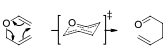
The Claisen rearrangement is a [3,3] sigmatropic rearrangement of allyl vinyl ethers to unsaturated carbonyl compounds. The rearrangement is a concerted pericyclic reaction proceeding via a chair-like transition state.
An aromatic Claisen rearrangement involves the conversion of allyl aryl ethers to an unstable ketone intermediate, which tautomerizes to give ortho-substituted phenols.
![Claisen rearrangement diagram, Δ, [3,3]-sigmatropic shift, chemical reaction process.](https://www.jove.com/files/ftp_upload/13097/13097_PT_Figure_2.svg)
However, ortho-substituted allyl aryl ethers exclusively yield para-substituted phenols via two sequential Clasien rearrangements.
![Claisen rearrangement diagram; reaction mechanism; organic chemistry; [3,3]-sigmatropic shift.](https://www.jove.com/files/ftp_upload/13097/13097_PT_Figure_3.svg)
Procedure
The Claisen rearrangement is an oxy-variant of the Cope reaction in which one of the saturated carbons of a 1,5-diene is replaced by an oxygen atom.
A simple example is the thermal isomerization of allyl vinyl ethers to γ,δ-unsaturated carbonyl compounds.
The equilibrium strongly favors the product since the rearrangement yields a compound with a stable carbon–oxygen bond.
Like the Cope rearrangement, the mechanism follows a concerted reorganization of six electrons, preferably via a chair-like transition state.
The reaction is highly stereoselective. For example, isomerization of substituted allyl vinyl ethers favors the stereoisomer where the double bonds adopt an E configuration.
Note that the product is derived from a chair-like transition state, where the substituent occupies an equatorial position.
In allyl aryl ethers, the rearrangement gives an unsaturated ketone intermediate, which tautomerizes into a stable enol form, restoring aromaticity to the ring.
If both ortho positions are occupied, the reaction proceeds via two sequential Claisen rearrangements to give the p-allyl product.