Overview
The benzylic position describes the position of a carbon atom attached directly to a benzene ring. Benzene by itself does not undergo oxidation. In contrast, the benzylic carbon is quite reactive in the presence of strong oxidizing agents such as KMnO4 or H2CrO4. Therefore, alkylbenzenes are readily oxidized to benzoic acid, irrespective of the type of alkyl groups.
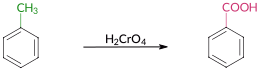
Halogen and nitro substituents on a benzene ring remain unaffected by these oxidizing agents.
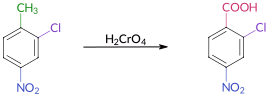
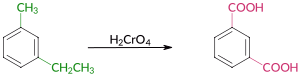
When more than one alkyl side chain is attached to the benzene ring, each gets oxidized to carboxyl groups.
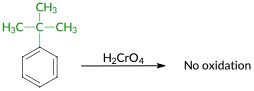
The only condition required for benzylic oxidation is to have at least one hydrogen at the benzylic position. This means that tert-butylbenzene, which lacks benzylic hydrogen, does not undergo oxidation.
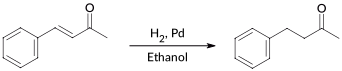
Benzene is also unreactive towards catalytic hydrogenation. A typical alkene double bond attached to a benzene ring can be selectively reduced under specific conditions without affecting the other functional groups. For example, in the selective reduction of 4-phenyl-3-buten-2-one to 4-phenyl-2-butanone, the benzene ring and ketone group remain unaffected.
Procedure
Any carbon bonded to a benzene ring is called a benzylic carbon, and the attached hydrogens are called benzylic protons or hydrogens.
Benzene is inert to most strong oxidizing agents and is reduced only under harsh conditions.
However, the benzylic position is susceptible to oxidation and reduction.
Typical alkenes and alkynes at the benzylic position can be selectively reduced, while the benzene ring and the carbonyl groups remain unaffected.
Further, most alkylbenzenes can be readily oxidized to benzoic acid, irrespective of the alkyl chain length.
Notably, substituents like halogen and nitro groups remain unaffected.
If more than one alkyl side chain exists, each gets oxidized to a carboxylic acid group.
However, in the absence of a benzylic hydrogen, oxidation does not occur.