Overview
Sulfonation of benzene is a reaction wherein benzene is treated with fuming sulfuric acid at room temperature to produce benzenesulfonic acid. Fuming sulfuric acid is a mixture of sulfur trioxide and concentrated sulfuric acid.

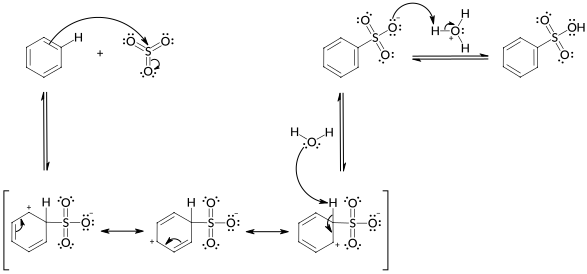
The active electrophile is either neutral sulfur trioxide or protonated sulfur trioxide ion, depending on the reaction conditions. One of the mechanisms involves neutral sulfur trioxide acting as an electrophile, which reacts with the π electron cloud of nucleophilic benzene, forming a resonance stabilized intermediate. Further, the loss of a proton from the intermediate restores its aromaticity. Finally, proton transfer from the solvent leads to the formation of benzenesulfonic acid.
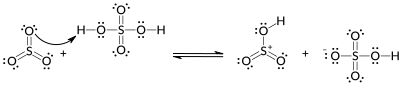
The other mechanism involves protonated sulfur trioxide ion as the electrophile, generated upon activation of sulfur trioxide through proton transfer from sulfuric acid.
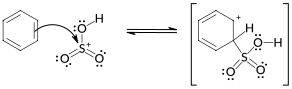
As an electrophile, the protonated ion attacks with the π electron cloud of benzene, forming an arenium ion.
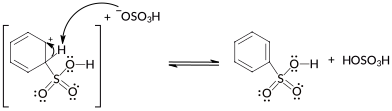
Finally, deprotonation of the arenium ion restores aromaticity, providing the benzenesulfonic acid as the final product and regenerating the acid catalyst.
Dilute sulfuric acid and steam can reverse the sulfonation reaction.
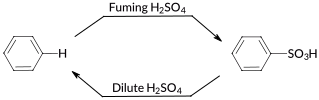
Aromatic sulfonation is widely used in the synthesis of detergents, dyes, and sulfa drugs.
Procedure
Sulfonation of benzene is a type of electrophilic aromatic substitution, where benzene reacts with fuming sulfuric acid or oleum, a mixture of sulfur trioxide and concentrated sulfuric acid, to form benzenesulfonic acid.
Depending on the reaction conditions, the reactive electrophile is either neutral sulfur trioxide or a protonated sulfur trioxide ion.
When the neutral sulfur trioxide is attacked by the π electron cloud of nucleophilic benzene, it forms a resonance-stabilized intermediate complex.
Deprotonation of the intermediate complex restores aromaticity.
Finally, proton transfer from the solvent generates benzenesulfonic acid as the product.
Alternatively, the proton transfer from sulfuric acid to sulfur trioxide forms a protonated sulfur trioxide ion.
The protonated electrophile is attacked by the π bond of benzene to form an arenium ion.
Finally, deprotonation of the arenium ion restores aromaticity, giving benzenesulfonic acid and regenerating the catalyst.
Notably, the sulfonation reaction can be reversed by passing dilute sulfuric acid in the presence of steam.