Overview
When more than one substituent is present on the benzene ring, the IUPAC nomenclature depends on the number of substituents present.
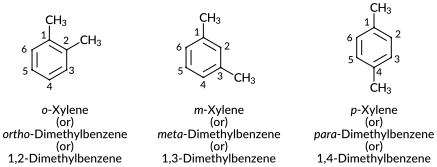
For disubstituted benzene derivatives, with two groups attached to the benzene ring, three constitutional isomers are possible. For example, consider dimethyl benzene, often called xylene, where the second methyl group can be substituted at the second, third, or fourth carbon. The relative position of the substituents is represented by prefixes ortho, meta, or para. These terms can also be represented with a single letter; ortho as ‘o’, meta as ‘m’, and para as ‘p.’ Numbers can also be used to indicate the relative position of the attached groups such as 1,2- for ortho, 1,3- for meta, and 1,4- for para. For example, the three different structures possible for dimethyl benzene are shown below.
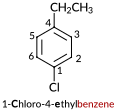
If the two substituents are different, they are numbered and listed in alphabetical order as a prefix to the benzene.
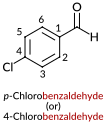
When one of the substituents is part of a common name, the compound is named as a derivative of that parent compound.
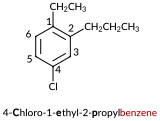
Polysubstituted benzene derivatives have three or more substituents attached to the benzene ring. To name them, numbers are used to indicate the relative positions of attached groups, and the lowest possible numbers are assigned to each group, as shown below.
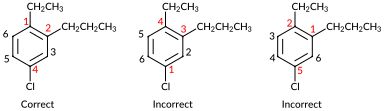
Finally, the substituents are alphabetically ordered as a prefix to the benzene, as shown below.
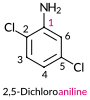
When one of the substituents imparts a common name, it is given locant 1, and the molecule is named as a derivative of that parent compound, as shown below.
Procedure
The IUPAC nomenclature of aromatic compounds with multiple substituents depends on the number and position of the substituents.
To name the disubstituted benzene derivatives, the substituent's positions are indicated either by using the prefixes ortho, meta, and para, abbreviated as o, m, and p, respectively, or using numbers like 1,2- for ortho, 1,3- for meta, and 1,4- for para.
If the two substituents are different, they are numbered and listed alphabetically.
When one of the substituents imparts a common name to the compound, the compound is named as a derivative of that parent molecule.
To name polysubstituted benzene derivatives with more than two substituents, numbers are used to indicate the positions of substituents.
The substituents are given the lowest possible numbers and are listed alphabetically.
If any substituent imparts a common name, it is assigned locant one, and the compound is named as the derivative of that parent molecule.