Other Types of Unconventional Unit Cells
Unconventional Unit Cells
The unit cells underlying the 14 Bravais lattices have the characteristics conventionally required for a unit cell: they have the smallest possible volume consistent with the symmetry of the crystal system.
However, it has been shown that primitive unit cells (P) can be identified for all centered cells: C (base-centered), F (face-centered), or I (body-centered). Unlike conventional non-primitive unit cells, these primitive cells do not necessarily adhere to the symmetry constraints of the crystal system in question.
For example, the primitive cell of a cubic F lattice is a rhombohedral cell with all equal axes and all angles equal to 60°, while the primitive cell of a cubic I lattice is a rhombohedral cell with angles α = 109.28°.
Although unconventional, these primitive cells correctly generate the entire lattice. They are sometimes preferred (especially in solid-state physics) because they contain only one lattice node, compared to the 2 nodes in C and I cells and 4 nodes in F cells.
Wigner-Seitz Cells
In general, the conventional unit cell is a parallelepiped, a particular type of polyhedron.
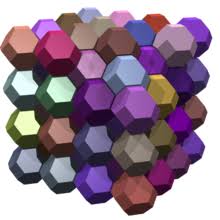
Many families of polyhedra can fill space by translation, not only parallelepiped.
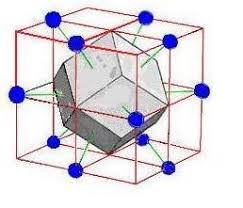
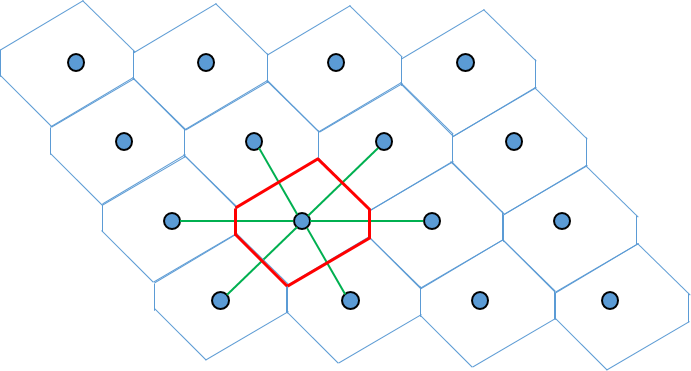
One important type of polyhedron is obtained through the Dirichlet construction: 1) Each lattice point is connected to its nearest neighbors by line segments;
2) At the midpoints of these segments, planes perpendicular to the segments are constructed;
3) The intersection of these planes defines a region of space known as the Dirichlet region, or more commonly, the Wigner-Seitz cell.
Example: Wigner-Seitz cell in two-dimensional space
Example: three-dimensional Wigner-Seitz cell